In a world increasingly defined by rapid change and external pressures, the pursuit of mental clarity has become a vital skill. Many people spend their lives reacting to circumstances, believing that their happiness is at the mercy of outside events. However, a deeper look at spiritual psychology suggests that our experience is not shaped by what happens to us, but by the beliefs we hold about those events. By shifting our perspective, we can transition from a state of vulnerability to one of unshakable peace.
The Myth of Vulnerability
The human ego is largely built on the idea of vulnerability. it suggests that we are fragile beings who can be “hurt” by the mistakes of others or by our own past errors. This belief system keeps us in a state of hyper-vigilance, constantly scanning the environment for potential threats to our peace or status.
However, true mental sovereignty begins when we question this premise. When we realize that our core identity is composed of consciousness rather than physical form or social reputation, the idea of “harm” begins to lose its grip. We start to see that while external situations may change, the stillness at the center of our being remains untouched.
Deconstructing Belief Systems
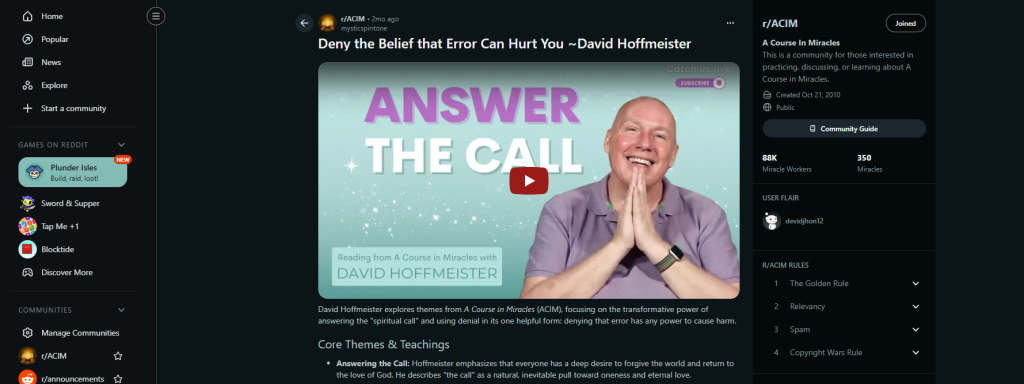
To experience a life free from chronic anxiety, one must be willing to look at the “content” of the mind. This involves identifying and denying the power of thoughts that advocate for suffering. In many contemporary spiritual circles, this process is known as “denying the belief that error can hurt you.”
Seekers often gather in digital spaces to share their journeys and offer support in this deconstruction process. For instance, the david hoffmeister reddit community provides a forum where individuals discuss the practical application of non-dualistic principles. By engaging with these shared insights, individuals learn to stop viewing their mistakes as catastrophic failures and start seeing them as simple “errors” in perception that can be easily corrected through forgiveness.
Practical Steps for Daily Resilience
Cultivating a resilient mind does not require an escape from the world; it requires a new way of being in it. Here are three practical ways to build mental strength:
- The Power of Non-Reaction: When someone criticizes you or a plan fails, pause before responding. Remind yourself that your peace is an internal decision that does not need to be surrendered to the situation.
- Active Forgiveness: Forgiveness is not about condoning bad behavior; it is about refusing to let past “errors” occupy your mental space in the present. It is an act of self-liberation.
- Mindful Awareness: Dedicate time each day to observe your thoughts without judgment. Recognizing a fearful thought as “just a thought” significantly diminishes its power over your emotions.
Living with Purpose and Ease
As we let go of the belief that we can be fundamentally damaged by the world, a natural sense of joy begins to emerge. We no longer move through life with a heavy shield, but with an open heart. This transformation allows for deeper relationships, greater creativity, and a consistent sense of purpose. By prioritizing the health of our internal state, we contribute to a more peaceful world, one thought at a time.